Model large text corpora without loading them all into RAM
Gensim can stream document vectors without loading the entire corpus. The dictionary, model and current training chunk still need memory. [2] [3] [4]
SeekVero editorial · Published · Prepared with AI assistance; no hands-on testing claimed.
Prepared from cited sources. No hands-on testing claimed.
What you can do
You can analyze a corpus too large for memory by streaming documents through the model instead of loading every file at once. That lets you look for themes, clusters, or topic structure in large text collections while keeping RAM use under control. [1]
Gensim is built for this kind of plain-text document analysis, so the practical result is a workflow that fits large corpora better than a load-everything approach. It is open-source Python software, which makes it a common starting point for this style of topic modeling. [1]
How it works in practice
The key idea is streaming: the model reads documents in sequence, processes them, and moves on instead of holding the full corpus in RAM. This is useful when the corpus is web-scale, or simply larger than the memory on one machine. [1]
A streaming corpus supplies vectors as the training algorithm requests them. Gensim LDA can make multiple passes; configure the source so each pass can read the documents again. Streaming is not a guarantee of a single pass or a fixed total RAM footprint. [2] [4]
- Split or expose your documents so they can be read one at a time or in small batches. [1]
- Feed the stream into a topic-modeling workflow that is designed for unsupervised analysis of raw text. [1]
- Keep document vectors on disk or supply an iterator; separately check dictionary size, model settings and training chunk size. [2] [3] [4]
| Option or question | What to know |
|---|---|
| Result | Large corpora can be analyzed without loading all documents into memory at once. [1] |
| Best fit | Plain-text, unsupervised document analysis on very large collections. [1] |
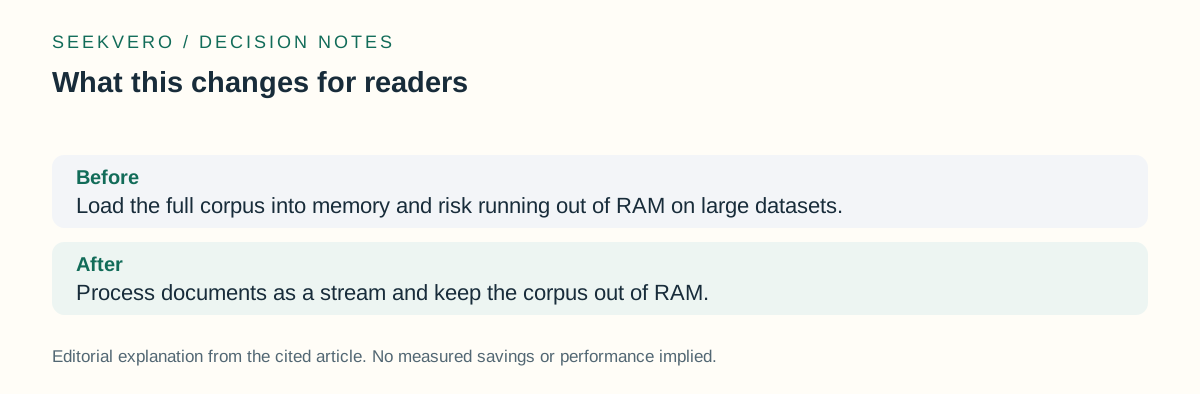
What this changes for readers
This matters when the question is not whether text analysis is possible, but whether it is practical on a large dataset. Streaming reduces the need for a machine with enough RAM to hold every document at once. [1]
The tradeoff is that you design for sequential processing rather than interactive in-memory browsing of the whole corpus. That is a different workflow decision, not just a technical detail. [1]
| Option or question | What to know |
|---|---|
| Before | Load the full corpus into memory and risk running out of RAM on large datasets. [1] |
| After | Process documents as a stream and keep the corpus out of RAM. [1] |
Streaming still uses memory
The LDA documentation scopes constant memory to the number of documents. That is narrower than promising no RAM spikes: preprocessing, a growing vocabulary, model settings and the active training chunk still matter. [2] [3]
If a job exceeds your memory budget, check what was loaded before training. Converting a streamed corpus with list(corpus) brings all its vectors into memory. A streaming library cannot undo that choice. [4]
| Option or question | What to know |
|---|---|
| Corpus | Read vectors progressively instead of keeping the whole collection in a Python list. [4] |
| Training chunk | chunksize controls how many documents enter each LDA training chunk. [2] |
| Vocabulary | Use dictionary filtering deliberately; retained word count and word IDs can change. [3] |
Check the pipeline before scaling it
Start with a representative subset and observe your own process memory. This is an evaluation procedure, not a measured result from SeekVero. Keep the preprocessing, vocabulary and model settings recorded so comparisons use the same conditions. [2] [3] [4]
- Build and filter the dictionary before producing the final bag-of-words vectors. If filtering changes IDs, regenerate those vectors using the filtered dictionary. [3]
- Save vectors as a Matrix Market corpus and reopen them through MmCorpus, or implement an iterable that supplies one vector at a time. [4]
- Choose a training chunk size and number of passes, confirm the corpus can be read again, then inspect topic quality and process memory on the subset before enlarging it. [2] [4]
Limits and what is not stated
The official intro confirms memory-independent streaming, but it does not give benchmark numbers, latency figures, or a measured speedup for this workflow. If you need those, they are not established here. [1]
Pricing is not established from the official intro page alone. The page identifies Gensim as free open-source software, but this does not by itself describe support plans, hosting costs, or any paid tier. [1]
Official next step
If you want to evaluate the supported large-corpus workflow, start with the official intro page. It explains the library’s design for semantic vector representation, unsupervised text analysis, and streaming over large corpora. [1]
Frequently asked questions
Can topic modeling work on a corpus that does not fit in RAM?
Yes. The official intro says Gensim supports data streaming and memory independence, so the corpus does not need to reside in RAM all at once. [1]
Is Gensim meant for this kind of text analysis?
Yes. The official intro describes it as free open-source Python software for semantic vector representation and plain-text, unsupervised machine-learning document analysis. [1]
Does the official page give performance benchmarks?
No measured benchmark numbers are stated on the intro page cited here. [1]
Next step
Use the official intro page to review the memory-independent streaming design and plain-text document analysis basics.
Read the official intro for the supported large-corpus workflow.