How everyday AI tasks got faster without a price change
A new AI model is built to finish well-scoped daily tasks faster while keeping the same pricing. [1]
SeekVero editorial · Published · Prepared with AI assistance; no hands-on testing claimed.
Prepared from cited sources. No hands-on testing claimed.
What that means in daily work
If you use AI for clear, everyday tasks like fixing bugs, polishing a document, or cleaning up a spreadsheet, Claude Sonnet 5.5 is meant to get that work done faster without changing the listed price. Anthropic says it is stronger on well-scoped daily tasks and that it runs 30%+ faster than Sonnet 5 while keeping the same token rates. [1]
- Example: a hypothetical project manager asks the model to rewrite a status update, turn notes into a slide outline, and flag a spreadsheet inconsistency. That is an INFERRED workflow example, not a measured customer result. [1]
| Option or question | What to know |
|---|---|
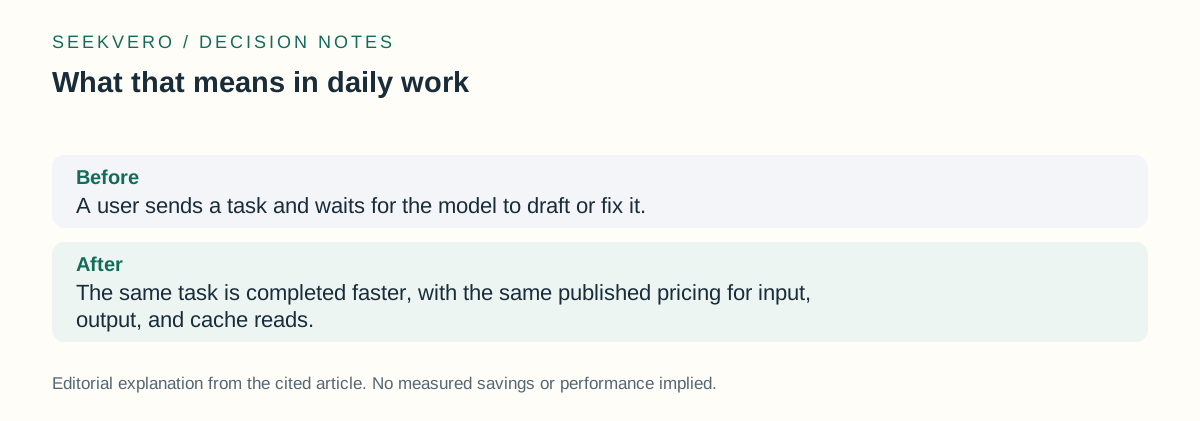
| Before | A user sends a task and waits for the model to draft or fix it. [1] |
| After | The same task is completed faster, with the same published pricing for input, output, and cache reads. [1] |
What Claude Sonnet 5.5 is and what it does
Claude Sonnet 5.5 is Anthropic’s announced model update for practical work, not a new pricing tier. Anthropic describes it as especially useful for fixing bugs and creating polished documents, slides, and spreadsheets, which suggests the model is tuned for tidy, narrow tasks rather than open-ended research. [1]
| Option or question | What to know |
|---|---|
| What stays the same | Anthropic says the pricing stays at $2 per million input tokens, $10 per million output tokens, and $0.20 per million cache reads. [1] |
| What changes | Anthropic says the model runs 30%+ faster than Sonnet 5 and typically uses fewer tokens per task. [1] |
Evidence and limits
Anthropic published the Claude Sonnet 5.5 announcement on September 28, 2026. The company says the model is 30%+ faster than Sonnet 5 and can cost up to 30% less per task because it typically uses fewer tokens. Those are company claims, so they should be read as vendor-reported performance, not an independent benchmark. [1]
| Option or question | What to know |
|---|---|
| Supported claim | Faster everyday task completion. [1] |
| Supported claim | Same published pricing as Sonnet 5. [1] |
| Limitation | Anthropic’s announcement does not prove every user will see the same speed or cost change. [1] |
What to do next
If you want to compare it with Sonnet 5 for your own work, start with one narrow task you already do often, such as rewriting a memo, fixing code, or summarizing a spreadsheet. Then compare the time it takes, the number of edits you need, and the token use if your setup shows that data. Read the official announcement for the details and current limits. [1]
Frequently asked questions
Is Claude Sonnet 5.5 cheaper?
Anthropic says the listed pricing stays the same as Sonnet 5, but it may cost up to 30% less per task because it usually needs fewer tokens. [1]
Is it faster for every task?
Anthropic says it is 30%+ faster than Sonnet 5, but that does not guarantee the same result for every prompt or workflow. [1]
Next step
Use the Anthropic announcement to review the release date, pricing, and stated performance claims directly.
Read the official announcement for the details.