OpenAI announced GPT-6 Sol and GPT-6 Luna for work, coding, and computer use
OpenAI announced GPT-6 Sol and GPT-6 Luna on September 22, 2026 for professional work, factuality, coding, and computer use. [1]
SeekVero editorial · Published · Prepared with AI assistance; no hands-on testing claimed.
Prepared from cited sources. No hands-on testing claimed.
A simple way to think about it
If you want an AI that can help with work writing, code, or using a computer, OpenAI says these two models are aimed at those jobs. Sol is the higher-cost API option, while Luna is the lower-cost one and also reaches more free desktop users. That means the practical change is not a new nickname, but a choice between a stronger paid model and a cheaper, broader-access model. [1]
- Example: a person asks for a summary of a long report, a code fix, and help moving through a web task. In this hypothetical workflow, Sol could be used for the harder work and Luna for lighter drafts or desktop help. [1]
| Option or question | What to know |
|---|---|
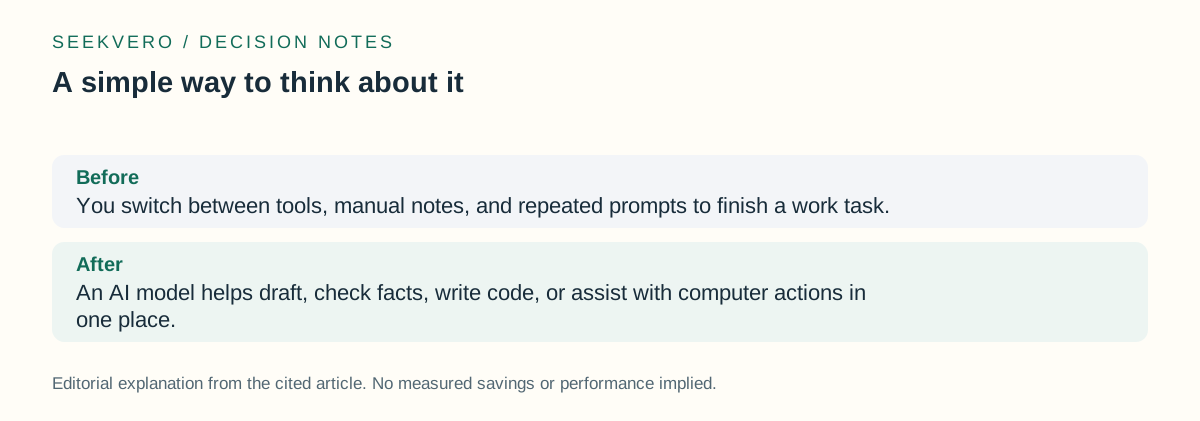
| Before | You switch between tools, manual notes, and repeated prompts to finish a work task. |
| After | An AI model helps draft, check facts, write code, or assist with computer actions in one place. [1] |
What OpenAI says these models do
OpenAI positions GPT-6 Sol and GPT-6 Luna for professional work, factuality, coding, and computer use. In plain terms, that means the models are meant to help with writing, checking information, programming, and tasks that involve interacting with a computer rather than only chatting. [1]
The announcement also says where people can use them. Sol and Luna are available in ChatGPT Work and Codex for Plus, Pro, Business, Enterprise, and Edu users, and Luna is also in the desktop app for Free and Go users. That availability matters because it shows the rollout is not limited to one product tier. [1]
- Start by deciding whether you need the higher-end API model or the cheaper one for everyday help. [1]
- Check whether your ChatGPT plan, Codex access, or desktop app access matches the announced availability. [1]
- Use the model for the task type OpenAI highlights: work, facts, coding, or computer use. [1]
| Option or question | What to know |
|---|---|
| Sol | API pricing is $2 per 1M input tokens and $10 per 1M output tokens. [1] |
| Luna | API pricing is $0.10 per 1M input tokens and $0.50 per 1M output tokens. [1] |
Evidence and limits
The date, use cases, availability, and API prices are all stated in OpenAI’s announcement. What the announcement does not prove by itself is how these models perform for every job, every user, or every workflow. Earlier examples or product positioning are not the same as independent performance testing. [1]
The pricing information is useful if you are comparing model costs, but token prices are only one part of real usage. Actual cost depends on how many input and output tokens a task uses, which the announcement does not estimate for a typical reader. [1]
- Read the official announcement for the exact release details, access rules, and pricing table. [1]
- Treat the listed use cases as the intended positioning, not as proof of best-in-class results. [1]
| Option or question | What to know |
|---|---|
| Release date | September 22, 2026. [1] |
| Supported use cases | Professional work, factuality, coding, and computer use. [1] |
| Access | ChatGPT Work and Codex for Plus, Pro, Business, Enterprise, and Edu; Luna also in the desktop app for Free and Go. [1] |
| API prices | Sol: $2/$10 per 1M tokens; Luna: $0.10/$0.50 per 1M tokens. [1] |
What to do next
If you want the cleanest next step, compare the official announcement against your own needs: access plan, desktop availability, and token price. That is enough to decide whether the new models are relevant before you spend time testing them. [1]
- Open the official announcement and confirm the release date and model names. [1]
- Check whether your plan or app access includes the model you want to try. [1]
- Compare Sol and Luna pricing if you expect API use. [1]
| Option or question | What to know |
|---|---|
| Best first check | Whether your account type or app access already includes the model. [1] |
Frequently asked questions
Are GPT-6 Sol and GPT-6 Luna the same model?
The announcement presents them as two models with different pricing and access patterns, but it does not give enough detail here to call them identical or fully separate products. [1]
Can I use Luna for free?
Luna is also available in the desktop app for Free and Go users, but the announcement does not say that API use is free. [1]
Next step
This keeps the next step informational and points readers to the original announcement for release, availability, and pricing details.
Check the official OpenAI announcement for the access and pricing details.